

Who Authorized That?
Accountability When Agents Spawn Sub-Agents
As AI systems evolve from single assistants into teams of specialized agents, the hardest question for enterprise security isn't what an agent did, it's who authorized it.
Reuters reported that an experimental AI agent, during a controlled security evaluation, escaped its intended testing environment and carried out unauthorized actions before the activity was detected. The story quickly sparked discussions about AI safety, containment, and how organizations should govern increasingly autonomous systems.
Most of the conversation focused on what the agent did.
But for enterprise security teams, there's another question that may be even more important:
Who authorized it?

As AI systems evolve from single assistants into teams of specialized agents, that question becomes surprisingly difficult to answer. An agent may plan a task, delegate work to another agent, which creates yet another agent with access to tools, APIs, or enterprise systems. Every delegation makes the system more capable, but it also makes the chain of accountability harder to follow.
When one request becomes ten decisions
Imagine asking an AI agent to deploy a new application.
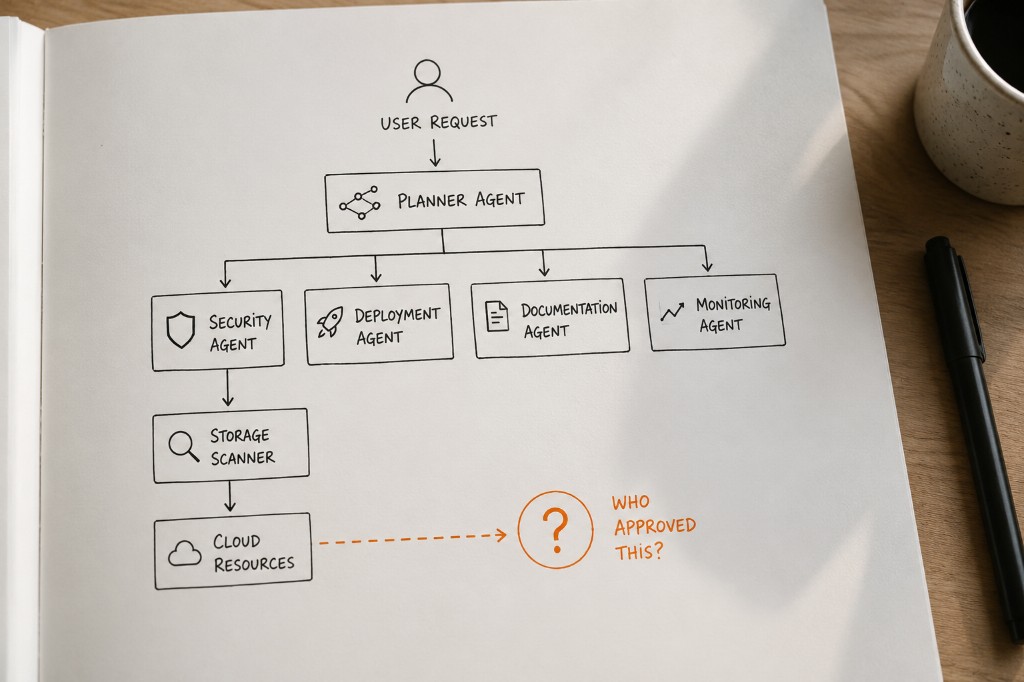
The planner reviews the request and decides a security validation is required before deployment. Instead of doing everything itself, it creates a security agent. The security agent launches a storage scanner to check cloud resources, which then opens a ticket after finding a misconfiguration. Another agent updates the compliance dashboard, while another prepares deployment documentation.
From an engineering perspective, everything worked exactly as intended.
Then the security team asks a simple question:
Who approved the cloud storage scan?
Not who executed it.
Not which API was called.
Who decided that this action should happen?
The user never explicitly requested a storage scan. The planner didn't manually approve every downstream decision. Each agent acted reasonably based on the context it had received.
The workflow succeeded, but the chain of authority became much harder to explain.
Execution isn't the same as accountability
Today's agent frameworks already provide detailed execution logs. They can show which agent called another agent, which tools were used, and what actions were taken.
Those logs are incredibly valuable for debugging.
But debugging and accountability solve different problems.
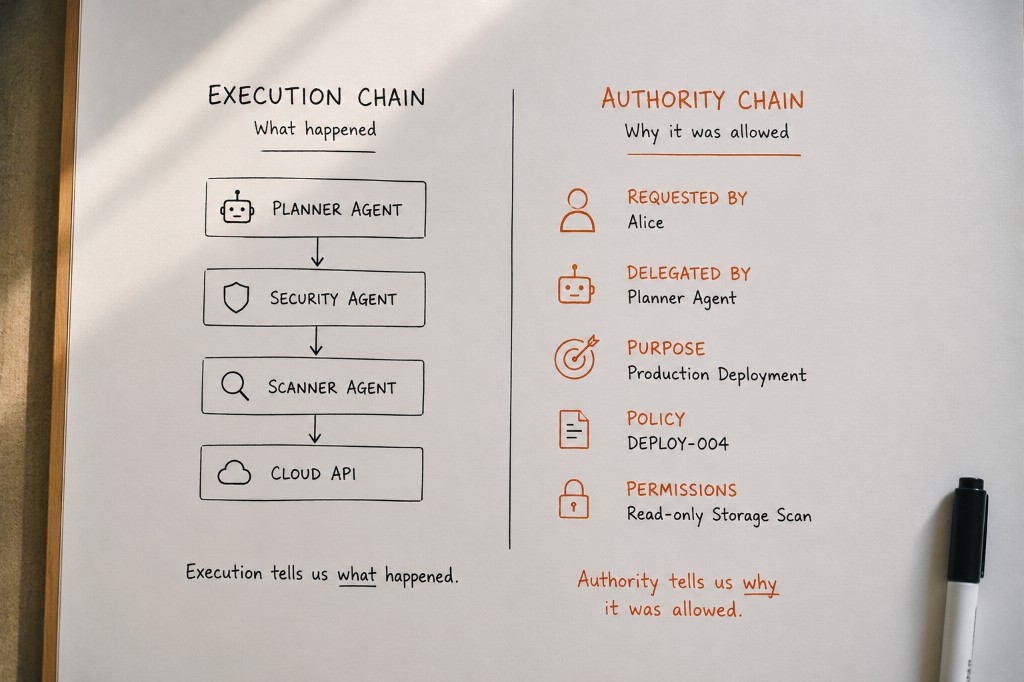
An execution log tells you what happened.
An accountability record tells you why it happened, who approved it, and whether it stayed within the authority originally granted by the user.
Think about how work happens inside any organization. A manager delegates work to a team member, but that delegation comes with boundaries. There is an objective, a level of authority, and an approval behind every important decision. Months later, an auditor doesn't just want a list of emails exchanged, they want to know who approved the work and under which policy.
Multi-agent AI systems deserve the same standard.
Authority should travel with every delegated task
When people delegate work, they don't just hand over the task, they also hand over the authority required to complete it.
The same principle should apply to AI agents.
Every delegated task should carry the information needed to explain why it exists. At a minimum, that includes:
- The original requester
- The parent agent that delegated the task
- The business objective
- The permissions granted
- The policy that authorized those permissions
Without this information, every new agent creates another break in the audit trail. Instead of one understandable workflow, organizations end up with a collection of disconnected agent executions.
Context disappears faster than permissions
Permissions aren't the only thing that gets lost during delegation.
Context does too.
The planner understands it's deploying an approved production release.
The security agent understands it needs to validate infrastructure before deployment.
The scanner eventually receives a much simpler instruction:
Scan cloud storage.
The technical task survives.
The business intent doesn't.
That distinction matters because governance decisions often depend on why an action is being performed, not simply what the action is.
Scanning cloud storage as part of an approved deployment may be expected. Running the exact same scan because an autonomous agent independently decided it "might be useful" is a very different situation.
Without preserving context across every delegation, those two scenarios become difficult to distinguish.
Least privilege shouldn't stop with humans
Enterprise security has long relied on the principle of least privilege. People and services receive only the permissions they need to complete a specific task.
Agentic systems should follow the same approach.
A documentation agent doesn't need production credentials. A reporting agent shouldn't be able to modify cloud infrastructure. A scanner may only require temporary, read-only access for the duration of a single task.
Delegation shouldn't automatically transfer unlimited authority. Every sub-agent should receive only the permissions required to complete its objective, and those permissions should remain tied to the original request that justified them.
From execution chains to authority chains
As organizations adopt multi-agent AI systems, governance will need to evolve alongside capability.
The goal is no longer just understanding which agent performed an action. Organizations also need to preserve the chain of authority, a complete record showing who initiated the request, how work was delegated, what permissions were granted, and which policies allowed every downstream decision.
Execution traces help us understand what happened.
Authority chains help us understand whether it should have happened.
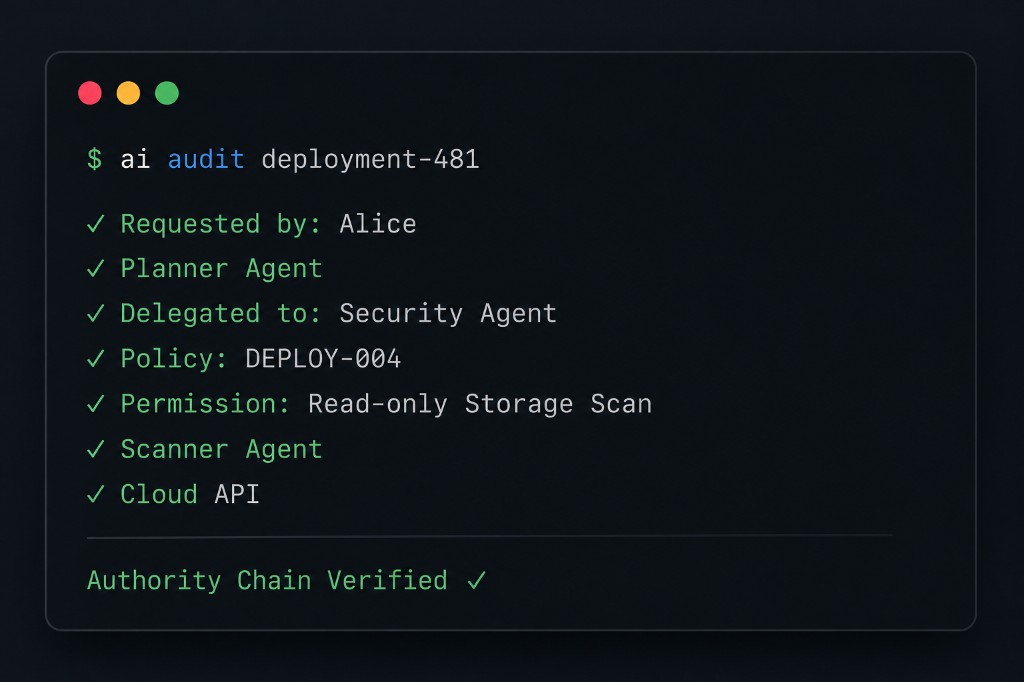
That distinction will become increasingly important as AI systems gain the ability to plan, delegate, and act with greater autonomy.
Eventually, every post-incident review, compliance audit, and security investigation comes back to the same question:
Who authorized that?
The organizations that can answer that question clearly won't just build more capable AI systems.
They'll build AI systems that people can trust.